In order to become a stronger artist, you must first identify the faults in your work. Human nature allows us to learn better through personal experience, as well as mistakes that we make. Critiques give us the oppertunnity to see through the eyes of others. This is very important, because more than likely you won't be the only one viewing your work. You want your pieces to be effective to you, and effective to the viewers.
Group Critiques
Due to time constraints, it is easier to critique together as a whole. Teachers and mentors often times do not have time to devote to each individual. Critiquing as a group makes it more efficient in order to give feedback, but still being able to give attention to each student. Group critique is important because you see your work through the eyes of many of your other peers. Through critiquing with other students, not only do you get informative feedback, you also learn the vocabulary and lingo of an artist. It is also helpful to recieve feedback from others while your work is in progress. Your classmates may be able to point out a detail that you overlooked, so you can change it before it becomes too far into the project.

[http://4.bp.blogspot.com/_4Ny_Z1cH02U/TIWywRMbx0I/AAAAAAAACRQ/BiJpZCvyJN
c/s1600/Critique1.JPG]
Individual Critiques
Individual critiques give you one on one time with your instructor. Group critique may not be what you need if you reach a difficult spot in your work. Having a meeting with your teacher makes it easier for you to get feedback or ask questions that you may see as embarrassing.
Key Questions for Critiquing Work
There are many different questions that you can ask whenever critiquing work. By keeping questions in mind, you are not only picking the piece apart, but you are developing your understanding of the work. Sometimes the point of the piece is not always right in front of you, and it takes a little thinking to grasp the main point. So, by keeping some of these questions in mind, you will have an easier time understanding, as well as giving better feedback to your fellow artist.
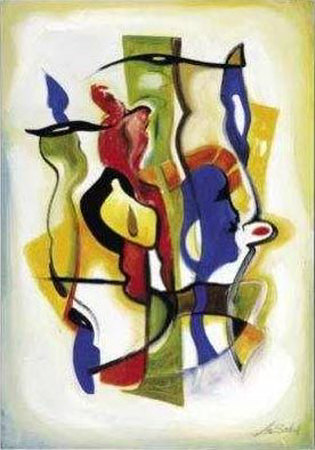
Questions Regarding Composition
*Balance: what kind, asymmetrical or symmetrical?
*Spatial planes: foreground, middle ground, background. Have they been addressed?
*Occupation of space: Does the piece show objects in the foreground, background, or middle ground?
*Space: Is there a good combination of negative and positive space?
*Interesting Manner: are the objects organized in an interesting manner?
*Is overlapping used?
*Are varying size used, or are all objects relatively the same size?
*Is the space cluttered or relatively empty?
*Is harmony evident?
*Do your eyes move throughout the piece or is there one main focal point?
*Tonal ranges: can you detect the light source?
*Value: is value used in just positive spots, or negative spots?
[http://cache2.allpostersimages.com/p/LRG/7/750/HVZZ000Z/posters/gockel-alfred-composition-i.jpg]
Questions Regarding Drawing
*What is the subject?
*What media and surface is used?
*What is the organizational element?
*What kind of lines are used, and do they create value?
*Do the lines vary or are they all similar?
*What kind of shapes are used?
*Are the shapes defined with texture or with value?
*Does the value indicate multiple light sources?
*Does the value create a mood structure?
*How many mediums were used?
*What kind of space is used?
Questions Regarding Figure Drawing
*Are proportions accurate?
*Can you determine the contour lines?
*Is the linework uniform between sharpness and width, or does it vary?
*Is the scale well done?

Questions Regarding Perspective
*Are different line qualities used to establish an understanding of the different spaces?
*Is tone and value used?
*Has placement been carefully considered?
*Do forms sitting on the horizon line appear to be floating, or do they sit firmly?
*Is overlapping used correctly?
*Are sizes used consistantly?
*Is there a gradiation from large to small?
*Is everything properly foreshortened?
*Do construction lines interfere with the finished project?
*Is the presentation strong?
Questions Regarding Color
*What color medium is used?
*Is a neutral-tinted surface used?
*Is a strong compostion established?
*Did you have the correct accessories to use the medium you chose?
*Did you have enough colors to work with?
*Did you use knowledge of color theory in your work?
*Were different colors used to establish light and dark, or were lighter and darker hues used?
*Are there signs of every color in the rainbow?
*Did they blend with their fingers or a blending tool?

[http://www.theaccidentalpm.com/wp-content/uploads/2009/02/color_wheel.jpg]

No comments:
Post a Comment